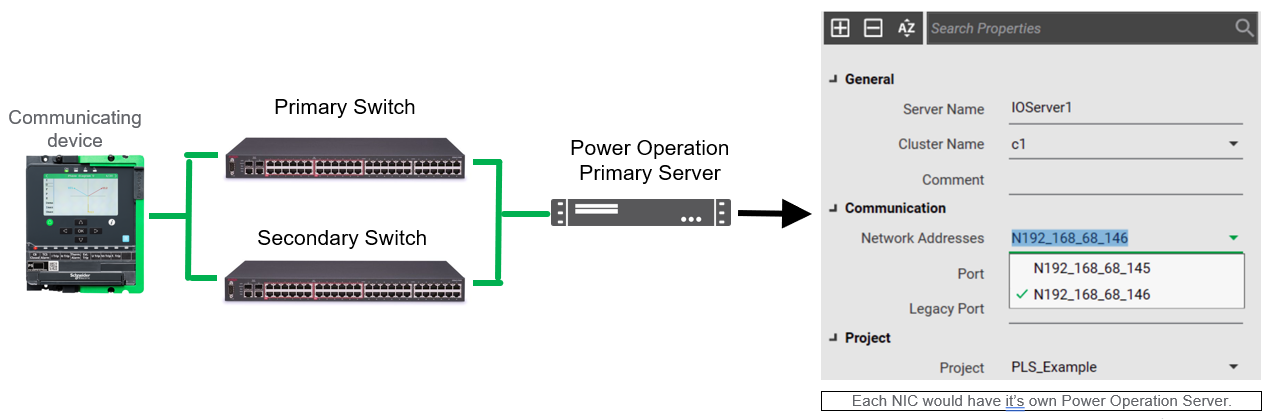
Server component architecture
Built-in architectural redundancy
Power Operation supports full server redundancy and full communication redundancy. When the Primary Server becomes unavailable, the Standby Server automatically takes over in 2 to 3 seconds.
There is also full data synchronization between servers and historical backfill. If primary goes down and a secondary becomes active, when the primary returns to active state the secondary fills in the primary with any missed information.
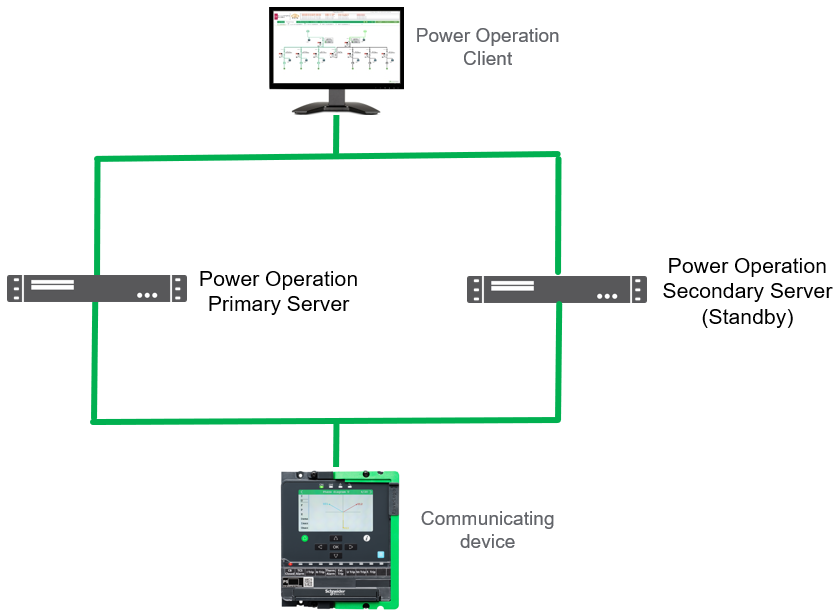
NOTE: Multiple NICs are supported on each server and a device may have two communication paths.
Making changes while online
Certain changes and updates to a production Power Operation system require a restart of the Power Operation Server processes. For example:
- Adding and removing devices
- Adding and removing tags
For this reason, if the customer requires changes to be made without interruption of service (restarting Power Operation Server), a redundant architecture is required.
In a redundant architecture, changes can be made without interrupting service by:
- Making a change on Secondary Server
- Restarting Secondary Server
- Making the updated Secondary Server the Primary Server
Ethernet network redundancy
When network redundancy is being considered, the most common approach is: Second LAN in parallel to first. If LAN1 becomes inoperative, components will maintain connection using LAN2.